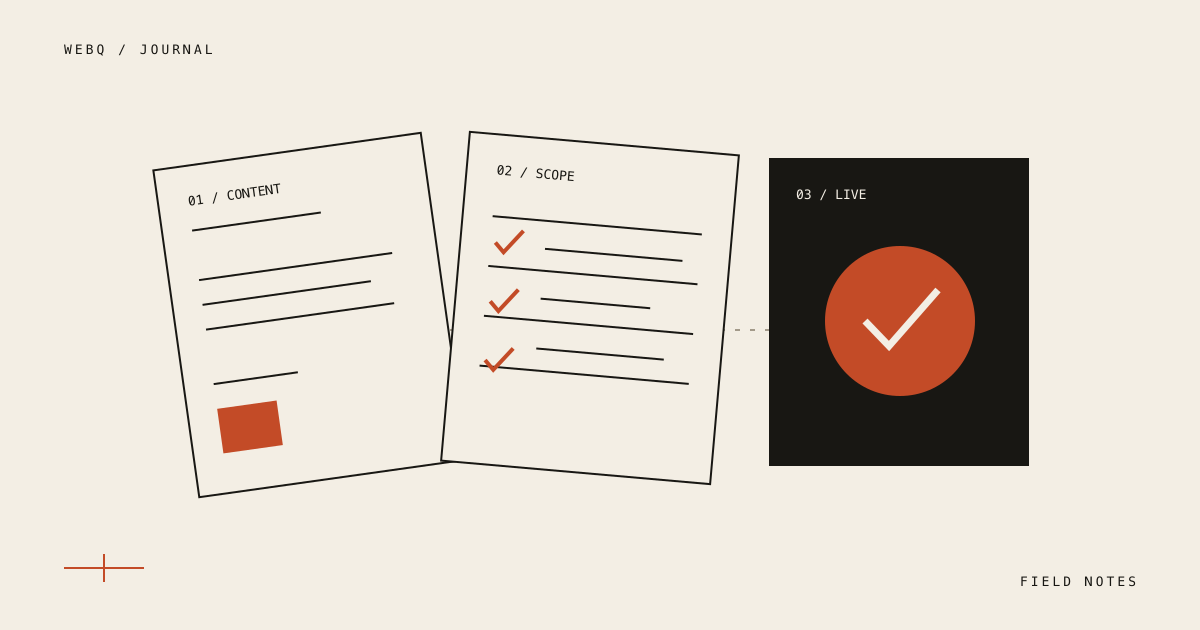
A fast website project starts before the first layout. The useful work is deciding what a visitor needs to understand, gathering the material that proves it, and making the next step easy to take.
A small business does not always need a new brand strategy or a custom application. Sometimes it needs a clear, credible home online: what the company does, who it helps, where it works, and how to get in touch. A short build can handle that job well when the inputs are ready.
Start with one customer question
Write a plain answer to this sentence: “We help this kind of customer do this specific thing.” A home-service business might write, “We install and repair residential garage doors across the north side of Pittsburgh.” That is a fictional example, but it shows the level of detail a designer can use.
“Quality solutions for every need” gives the reader much less to work with. If the business has several services, choose the one that should lead the homepage and name the others clearly. You can expand the site later without making the first version vague.
Put the essential material in one folder
A ready brief usually needs five groups of information:
- Identity: the company name, existing logo, colors if they are established, and the correct contact details.
- Offer: the services you want to sell, what is included, and who each service is for.
- Proof: original photos, permission-cleared project examples, and reviews you are allowed to publish.
- Practical details: service area, working hours, address where relevant, and the person who receives inquiries.
- Access: the domain account and any hosting, calendar or payment accounts required for the agreed scope.
Use descriptive file names. “Kitchen renovation, after, September” is easier to place than “IMG_4481.” Mark anything private or unsuitable for publication before sharing it. A designer should not have to guess which photograph is safe to use.
Choose the action before choosing the layout
A visitor can request an estimate, call, book a slot or leave a deposit. Those are different journeys. The page should make the intended one obvious.
For an estimate, a short contact form may be enough. For a repeatable service with a known duration, appointment scheduling may make more sense. If the scope varies from customer to customer, collecting payment immediately can create extra questions instead of resolving them.
The launch brief should name the action and the destination: which inbox receives the request, which calendar owns the booking, and which account receives the payment. Read our guide to choosing an inquiry or booking flow if this decision is still open.
Keep the first release small enough to finish
A useful starting structure is a homepage, services, about, contact, and one additional page that the business actually needs. This is a planning example, not a rule that every company needs five pages.
Two carefully chosen project examples can be stronger than a gallery of unfinished placeholders. An honest short biography is better than a page filled with generic team claims. If a feature depends on material you do not have yet, put it on the next-release list.
At Webq, the Business Site offer is built around this focused launch: supplied identity and content, up to five pages, and a clear customer action. Its 1–2 business-day delivery window starts after written scope approval, with content and access ready and 100% payment received. Feedback and third-party approvals can extend launch.
Review the path, not only the screenshot
Before going live, open the site on a phone and behave like a new customer. Find the relevant service, follow the primary button, submit an agreed test inquiry, and check that it reaches the correct destination. Read the confirmation message. Check the phone number and opening hours.
The finished first release should answer three things without explanation from its owner: what you do, why someone should trust you, and what they should do next.
Start a brief when the essentials are gathered. A concise brief with real material gives the build somewhere solid to start.